How to Avoid Outdoor Lighting Risks: The Ultimate Safety Guide
Exterior electrical infrastructure and landscape illumination engineering intersect complex human safety codes, structural fire prevention standards, electrochemical moisture degradation dynamics, and nocturnal environmental management. Property managers, municipal electrical inspectors, and landscape architects navigating how to avoid outdoor lighting risks frequently confront a fragmented technical landscape dominated by consumer-grade shortcuts rather than rigorous industrial safety protocols. Specifying and maintaining reliable exterior lighting installations requires analyzing line-voltage surge paths, sub-grade galvanic corrosion vectors, thermal dissipation limits within sealed luminaires, and compliance with national electrical codes.
Beneath the polished facade of modern hardscape and architectural illumination, external systems endure severe environmental abuse. Furthermore, sub-grade moisture migration, aggressive root growth, landscape maintenance machinery impacts, and dramatic thermal cycling continuously test the structural and dielectric integrity of cabling, transformers, and housings. Without a structured risk-mitigation framework, operators frequently mistake cosmetic durability for genuine electrical safety, resulting in chronic ground faults, property damage, and severe shock hazards. Consequently, achieving long-term system safety demands comprehensive engineering discipline and proactive hazard analysis.
Navigating these operational complexities meanwhile requires balancing initial capital expenditure against long-term safety liabilities and regulatory code mandates. Additionally, the following reference explores diagnostic frameworks, electrical safety taxonomies, hazard variations, economic frameworks, and multi-year governance protocols for professional exterior lighting risk management.
Understanding How to Avoid Outdoor Lighting Risks

When safety engineers and experienced facility directors evaluate how to avoid outdoor lighting risks, they look past superficial wiring neatness to analyze ground-fault protection thresholds, transformer thermal load capacities, and enclosure water ingress ratings. Senior technicians specifically examine how direct-burial cable insulation degrades when exposed to acidic soil composition and heavy lawn-care equipment vibration. A robust risk-management framework rejects reactive troubleshooting; rather, it categorizes electrical threats by voltage tier, enforces strict overcurrent protection, and traces mechanical installation errors back to root causes. Meanwhile, common market confusion treats outdoor lighting safety as a simple plug-and-play exercise, thereby compounding electrical hazards and structural vulnerabilities.
Effective risk planning balances immediate shock hazard prevention against long-term thermal and environmental resilience. When installers oversimplify this process, they fail to account for how an improperly grounded line-voltage fixture can energize exterior metal handrails during a wet weather event. For instance, replacing a blown fuse without investigating the underlying ground fault guarantees a recurring electrical hazard that threatens property occupants.
Furthermore, ignoring proper wire stripping and silicone gel encapsulation during underground splice repairs leads to rapid moisture tracking and catastrophic short circuits. Specifically, water entering low-voltage lines mixed with electrical current creates high-resistance corrosion points that generate intense localized heat. Ultimately, mastering how to avoid outdoor lighting risks treats exterior infrastructure management as a precision electrical safety science.
Deep Contextual Background
The evolution of outdoor lighting safety protocols tracks parallel to the technological transition from hazardous legacy high-voltage systems to modern low-voltage solid-state arrays and intelligent surge-protected networks. Historically, exterior lighting relied heavily on exposed line-voltage junction boxes, rigid metal conduits prone to moisture condensation, and fragile incandescent lamps that posed severe thermal and shock risks. These old configurations demanded deep trenching and frequently violated evolving national electrical codes as soil shifts compromised metal conduit integrity.
Eventually, the commercial standardization of 12-volt low-voltage landscape lighting systems and National Electrical Code guidelines transformed safety standards by reducing shock hazards and permitting shallow trenching. Concurrently, the proliferation of solid-state LEDs and transient voltage surge suppressors introduced new protective capabilities against lightning and grid switching transients. Despite these technical improvements, however, improper DIY installations, cheap imported components, and lack of professional grounding continue to introduce severe operational hazards.
Modern regulatory standards, including stringent building codes and municipal safety mandates, have further elevated the rigor expected from exterior electrical installations. Facilities managers increasingly demand documented audit trails, precise multimeter diagnostics, and adherence to certified waterproof standards. Therefore, contemporary risk management must prioritize systematic electrical isolation, weather-sealed component selection, and preventative infrastructure reinforcement.
Conceptual Frameworks and Mental Models
Navigating the operational intricacies of exterior lighting risk mitigation becomes more manageable when applying specific mental models to evaluate electrical hazards, structural failure points, and safety sequencing.
-
The Dielectric Breakdown and Insulation Integrity Matrix: Maps soil moisture acidity and cable jacket aging to predict dielectric failure before electrical shorts occur. Limit: However, unexpected mechanical damage from landscaping shovels can instantly bypass predicted insulation lifespans.
-
The Ground-Fault Current Path and Protection Model: Evaluates how fault currents return safely to the circuit breaker trip threshold without energizing exterior metal surfaces. Limit: Nevertheless, high-resistance ground paths can prevent standard breakers from tripping instantly.
-
The Thermal Dissipation and Enclosure Sealing Taxonomy: Assesses how internal luminaire heat escapes sealed housings without allowing sub-grade moisture to enter. Limit: Assuming proper initial seals, extreme temperature swings can still compromise rubber gasket elasticity over time.
-
The Transient Voltage Surge and Protection Hierarchy: Guides the placement of protective surge suppression devices along long wiring runs to absorb lightning spikes. Limit: Consequently, direct lightning strikes can overwhelm sacrificial surge protectors, requiring manual device replacement.
Key Categories or Variations
Exterior lighting risks and their respective mitigation strategies fall into distinct technical classifications. Each category carries specific trade-offs regarding diagnostic complexity, specialized tooling requirements, and labor time.
| Risk Mitigation Category | Primary Technical Focus | Typical Target Infrastructure | Main Trade-offs |
| Ground-Fault Circuit Interrupter Protection | Installing sensitive GFCI breakers and receptacles to prevent lethal shock | Line-voltage architectural wall-packs, pond lights, and patio outlets | Immediate shock protection; furthermore, prone to nuisance tripping if moisture enters poorly sealed fixtures. |
| Direct-Burial Cable and Splice Sealing | Rebuilding underground wire connections using waterproof silicone gel encapsulation | Low-voltage mainline runs and sub-grade fixture pigtail connections | Prevents underground corrosion; however, requires careful excavation and precise wiring practices. |
| Thermal Management and Driver Protection | Ensuring adequate ventilation and thermal sinking inside enclosed luminaires | Commercial floodlights, bollards, and high-output LED wall-packs | Extends electronic lifespan; nevertheless, complex thermal engineering increases initial hardware cost. |
| Transient Voltage Surge Suppression | Shielding sensitive electronic drivers and smart controllers from lightning spikes | Centralized low-voltage transformers and networked smart control hubs | Protects expensive electronics; along with requiring periodic replacement of sacrificial surge modules. |
| Mechanical Re-Anchoring and Impact Shielding | Stabilizing leaning poles and protecting fixtures from lawn equipment collisions | Commercial parking lot poles, bollards, and pathway path lights | Prevents structural collapse; along with higher installation labor and concrete foundation work. |
| Waterproof Seal and O-Ring Restoration | Replacing degraded rubber gaskets and cracked glass lenses on exposed fixtures | In-grade paver lights, underwater fountain units, and ground path lights | Eliminates internal water siphoning; however, requires delicate disassembly of weather-hardened parts. |
Realistic Decision Logic
When evaluating these risk mitigation strategies against site conditions, facilities managers weigh labor expenditure against potential liability exposure. For example, commercial public spaces warrant meticulous GFCI integration and heavy-duty bollard protection because pedestrian safety liabilities are extremely high. Conversely, private residential gardens focus primarily on low-voltage safety isolation and waterproof gel splice caps to prevent nuisance transformer faults.
Detailed Real-World Scenarios
Scenario A: Commercial Retail Strip with Wet-Location Wall-Pack Shocks
-
Constraints: A commercial strip center where metal wall-pack fixtures near customer walkways occasionally deliver mild tingles when touched during heavy rain.
-
Decision Points: Testing earth-ground continuity, inspecting internal wiring for insulation wear, and installing dedicated GFCI breakers at the main panel.
-
Failure Modes: Technicians simply wiping down the fixture exterior without checking internal grounding continuity, leaving the underlying shock hazard active.
-
Second-Order Effects: Re-securing the ground wire and upgrading to a weather-resistant GFCI breaker eliminates the shock hazard, ensuring full code compliance and customer safety.
Scenario B: Waterfront Residential Estate with Submerged Pond Lighting Failures
-
Constraints: Frequent electrical breaker trips on a low-voltage transformer powering underwater koi pond and fountain illumination fixtures.
-
Decision Points: Isolating individual underwater fixtures, testing transformer output resistance, and replacing waterlogged housing seals with marine-grade waterproof potting.
-
Failure Modes: Reusing old, cracked rubber O-rings during reassembly, allowing water to infiltrate the low-voltage halogen and LED housings immediately.
-
Second-Order Effects: Utilizing factory-sealed IP68 waterproof fixtures and marine-grade potting compounds prevents recurring electrical shorts and transformer overloads.
Scenario C: Large Municipal Park with Lightning-Damaged Smart Controls
-
Constraints: Frequent electrical storms destroying expensive smart lighting gateways, wireless mesh transceivers, and centralized LED drivers.
-
Decision Points: Installing heavy-duty transient voltage surge suppression devices on both the primary AC input and secondary low-voltage lines.
-
Failure Modes: Relying solely on internal driver protection without installing exterior service-entrance surge arresters.
-
Second-Order Effects: Comprehensive multi-stage surge protection successfully absorbs high-voltage lightning transients, protecting the municipal lighting network from total destruction.
Scenario D: Suburban Corporate Campus with Lawn-Mower Cable Severing
-
Constraints: Commercial landscaping crews regularly slicing shallow direct-burial low-voltage cables with string trimmers and lawn aerators.
-
Decision Points: Excavating affected runs, re-routing cables inside heavy-duty schedule 40 PVC conduit, and burying lines below standard aerator depth.
-
Failure Modes: Splicing severed wires with standard electrical tape and burying them directly in damp soil without waterproof gel caps.
-
Second-Order Effects: Proper conduit protection and silicone gel splice encapsulation permanently end recurring cable failures and eliminate exposed wire shock risks.
Planning, Cost, and Resource Dynamics
Establishing a comprehensive program on how to avoid outdoor lighting risks involves balancing upfront safety equipment outlays, professional electrical inspection fees, and long-term liability reduction. Financial variability typically stems from system scale, voltage tier complexity, and existing infrastructure condition.
| Risk Mitigation Tier | Financial Range (USD) | Primary Variables |
| Basic Safety Audit & Gel Splicing | $150 – $500 per zone | Waterproof connector kits, multimeter diagnostic labor, basic hand tools |
| GFCI and Surge Protection Upgrades | $300 – $1,200 total | Weatherproof GFCI breakers, service surge arresters, electrical labor |
| Conduit Trenching & Rewiring | $1,000 – $4,000 | Heavy-duty PVC conduit, trenching equipment rental, direct-burial wire |
| Commercial Pole & Fixture Overhaul | $2,500 – $8,000+ | Industrial surge suppression, structural re-anchoring, certified technicians |
-
Direct Costs: Waterproof splice kits, surge suppression devices, GFCI breakers, conduit materials, replacement luminaires, and cable.
-
Indirect Costs: Professional electrical engineering audits, permitting fees, trenching labor, and landscape turf restoration.
-
Opportunity Costs: Delaying essential electrical safety upgrades exposes property owners to catastrophic fire risks, lethal shock liabilities, and costly insurance claim denials.
Tools, Strategies, and Support Systems
Executing precise exterior risk management requires an ecosystem of specialized diagnostic instruments, personal protective equipment, and material support supplies.
-
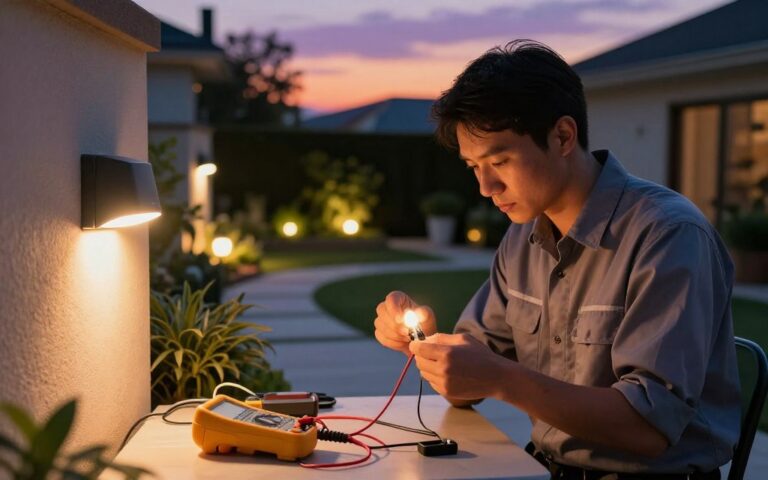
Digital True-RMS Multimeters: Essential for verifying earth ground continuity, measuring circuit voltage drop, and checking insulation resistance. Limit: However, standard multimeters cannot test high-voltage dielectric breakdown under wet stress conditions.
-
Insulation Resistance Testers (Megohmmeters): Inject high test voltages to evaluate the true dielectric integrity of direct-burial cable insulation and transformer windings. Limit: Improper high-voltage testing can damage sensitive electronic LED drivers if not disconnected first.
-
Ground Resistance Clamp Meters: Measure earth ground rod resistance without disconnecting ground rods from active electrical systems. Limit: High soil resistivity or concrete encasement can distort clamp meter accuracy.
-
Digital Circuit Tracers: Locate buried lines and pinpoint hidden electrical faults without destructive trench excavation. Limit: Heavy soil mineralization and metallic rebar can interfere with signal tracing accuracy.
-
Torque Wrenches: Ensure electrical terminal lugs and waterproof housing compression bolts are tightened to precise manufacturer specifications. Limit: Over-torquing can strip metal threads or crack glass lenses, inviting water entry.
-
Personal Protective Equipment (PPE): Insulated gloves, safety glasses, and arc-flash protection gear required when servicing line-voltage transformers and electrical panels. Limit: PPE compliance relies entirely on technician discipline and training.
Risk Landscape and Failure Modes
Exterior lighting installations present significant technical hazards, subjecting systems to moisture ingress, electrical surges, thermal degradation, and mechanical damage. Understanding failure modes prevents compounding safety breakdowns.
-
Inadequate Earth Grounding: Failing to bond metal fixture housings to a certified earth ground creates lethal shock pathways if internal hot wires touch metal bodies.
-
Sub-Grade Splicing Failures: Using standard indoor wire nuts instead of waterproof silicone gel caps allows soil moisture to corrode conductors and trip breakers.
-
Thermal Runaway in Enclosed Fixtures: Operating high-wattage lamps inside poorly ventilated housings causes internal component overheating, insulation melting, and potential fire risks.
-
Lightning Surge Propagation: Unprotected low-voltage transformer windings act as signal paths, transmitting high-voltage lightning transients directly into connected buildings.
-
Mechanical Abrasion on Unprotected Cable: Laying direct-burial wire across sharp rocks or hardscape edges causes jacket abrasion and eventual ground-fault short circuits.
Governance, Maintenance, and Long-Term Adaptation
Maintaining optimal safety and risk management across multi-year operational cycles requires structured governance protocols, regular electrical audits, and proactive hardware maintenance.
-
Monitoring Cycles: Conducting bi-annual electrical safety audits and post-storm inspections catches minor insulation degradation before hazardous failures occur.
-
Adjustment Triggers: Facility operators initiate immediate corrective maintenance whenever a GFCI trips, insulation resistance drops below safe thresholds, or physical damage occurs. Consequently, ignoring intermittent GFCI trips invites catastrophic electrical shocks.
-
Layered Maintenance Checklist:
-
Testing all exterior GFCI breakers and receptacles using built-in test buttons to confirm mechanical trip responsiveness.
-
Inspecting central transformers for enclosure rust, insect nests, and secure earth-ground bonding connections.
-
Verifying that surge protection indicator lights remain active to confirm electrical shielding integrity.
-
Checking direct-burial cable entry points and junction box seals for signs of cracking or moisture intrusion.
-
Measurement, Tracking, and Evaluation
Evaluating the success of an outdoor lighting risk management program balances quantitative electrical metrics against qualitative safety compliance indicators.
-
Quantitative Indicators: Measured via diagnostic test logs. Key benchmarks include tracking insulation resistance megohm values, verifying earth ground resistance under twenty-five ohms, and recording zero electrical shock incidents.
-
Qualitative Signals: Assessed through visual verification of secure fixture mountings, absence of moisture inside optical housings, and flawless automated switching execution.
-
Documentation Examples:
-
Electrical Safety Audit Report: Comprehensive documentation recording ground continuity test results, insulation resistance values, and surge protection statuses.
-
Master Infrastructure Map: Scaled site drawings marking buried cable routes, transformer stations, and grounding electrode locations.
-
Maintenance and Incident Logbook: Historical ledgers tracking component replacements, GFCI trip events, and certified electrical inspection dates.
-
Common Misconceptions and Oversimplifications
-
Myth: Low-voltage 12-volt landscape lighting systems are entirely risk-free and require no grounding or safety precautions. Correction: Instead, while low voltage reduces shock severity, overloaded transformers and shorted cables can still generate extreme heat and fire hazards.
-
Myth: Standard indoor wire nuts and electrical tape provide adequate waterproofing for underground wire splices. Correction: On the contrary, standard tape degrades immediately in damp soil, requiring specialized silicone gel caps or resin-filled splice kits.
-
Myth: Exterior lighting fixtures never require electrical safety checks after initial installation. Correction: In contrast, soil settling, lawn equipment impacts, and thermal cycling constantly degrade insulation, requiring regular diagnostic audits.
-
Myth: Installing surge protection is unnecessary if an estate has never experienced a direct lightning strike. Correction: Rather, indirect grid switching spikes and nearby lightning strikes travel along wiring runs, destroying sensitive electronic drivers without warning.
-
Myth: Grounding outdoor fixtures to local water pipes or structural rebar is an acceptable substitute for dedicated ground rods. Correction: Modern electrical codes prohibit improper bonding, requiring dedicated, verified earth grounding electrodes.
-
Myth: Waterproof ratings are permanent and immune to environmental aging over time. Correction: Rather, rubber O-rings and gasket seals harden and crack from UV exposure and thermal cycling, requiring periodic inspection and replacement.
Ethical, Practical, and Contextual Considerations
Responsible exterior lighting risk management extends beyond private property boundaries to impact community safety and legal compliance. Faulty wiring, ungrounded metal fixtures, and exposed line-voltage splices pose severe safety hazards to children, pets, and maintenance personnel working in landscaped areas. Furthermore, improper disposal of burnt-out LED drivers, electronic ballasts, and mercury-containing legacy lamps contributes to environmental contamination if not routed through certified electronic recycling streams.
Adhering strictly to National Electrical Code standards, utilizing certified waterproof components, and practicing responsible e-waste recycling ensures safety operations remain robust, sustainable, and legally compliant. Balancing mechanical safety, code compliance, and environmental stewardship ensures exterior lighting networks remain dependable long-term assets.
Conclusion
Mastering how to avoid outdoor lighting risks requires synthesizing electrical safety codes, moisture barrier physics, and rigorous diagnostic discipline. Instead of relying on reactive fixes, property managers and engineers who implement structured risk-management frameworks build resilient, secure exterior systems that withstand severe environmental extremes. Consequently, disciplined safety management transforms chronic electrical hazards into predictable, streamlined operational protocols. Thus, rigorous technical evaluation elevates the standard of contemporary landscape infrastructure management.