How to Manage Outdoor Lighting Wiring Issues: The Ultimate Guide
Exterior electrical distribution networks operate under punishing environmental conditions, contending with continuous ground moisture, subsurface shifting, thermal expansion, and mechanical stress from landscaping equipment. Specifically, property managers, electrical contractors, and facility supervisors frequently encounter intermittent ground faults, voltage drop anomalies, and corroded splices that jeopardize entire illumination arrays. Addressing these systemic vulnerabilities requires a granular examination of conductor gauge selection, insulation class integrity, splice encapsulation methods, and circuit load balancing across extended operational runs.
Beneath the turf and hardscape of modern grounds, exterior wiring networks endure relentless degradation from galvanic corrosion and insulation micro-cracks. Consequently, without a rigorous diagnostic framework, technicians often mistake recurring breaker trips for faulty fixtures rather than tracing the fault back to compromised subsurface conductors or water-logged junction boxes. Thus, achieving long-term network stability demands methodical insulation testing, professional splicing protocols, and systematic circuit documentation.
Navigating these technical and physical hurdles simultaneously nevertheless requires balancing initial installation costs against long-term maintenance overhead and reliability. Furthermore, the following reference explores diagnostic models, wiring calculation structures, economic optimization frameworks, risk taxonomies, and multi-year governance protocols for professional landscape electrical engineering.
Understanding how to manage outdoor lighting wiring issues
When facility technicians and electrical specialists evaluate how to manage outdoor lighting wiring issues, they look past superficial symptoms like flickering lamps or tripped breakers. Instead, they analyze total circuit amperage draw, conductor resistance coefficients, insulation resistance values, and splice potting integrity. Senior electricians specifically examine how an unmanaged low-voltage run experiencing severe voltage drop forces system drivers to draw excessive current, accelerating thermal wear along the entire cable length. Consequently, a robust electrical maintenance framework rejects temporary tape repairs. Rather, it categorizes circuit faults by diagnostic signatures, enforces strict megohm testing protocols, and traces anomalies back to core distribution parameters. Meanwhile, common market confusion treats wiring failures as unavoidable consequences of weather exposure, thereby compounding electrical hazards and shortening hardware lifespans.
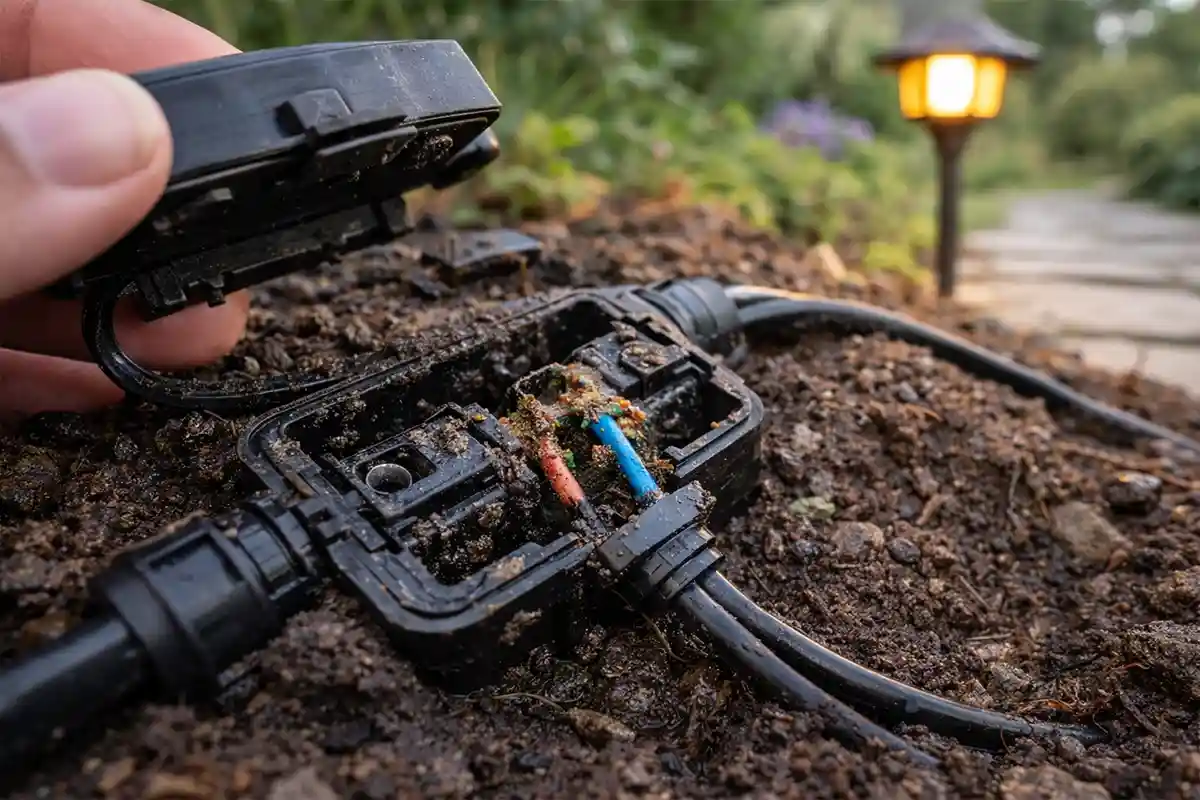
Effective electrical management balances proper wire gauge sizing against sealed splice protection to eliminate ground faults and voltage starvation. When operators oversimplify this process, however, they fail to account for how capillary action draws ambient moisture backward through stranded copper wire strands into terminal blocks. For instance, maintaining unsealed underground splices that absorb soil moisture guarantees perpetual circuit trips regardless of modern luminaire upgrades.
Furthermore, ignoring proper trench depth and conduit protection leads to repeated mechanical severance from shovels and aeration tools. Specifically, shallow burial practices leave cables vulnerable to surface pressure and shifting frost lines, inflating emergency repair budgets. Ultimately, mastering how to manage outdoor lighting wiring issues treats exterior electrical infrastructure as a precision diagnostic and preventive maintenance discipline.
Deep Contextual Background
The evolution of outdoor wiring management tracks parallel to the technological transition from rigid line-voltage conduit systems to flexible low-voltage direct-burial networks and smart lighting architectures. Historically, exterior illumination relied on heavy-duty 120-volt metal conduit networks that demanded deep professional trenching, concrete encasement, and complex weather-proof junction boxes. These legacy configurations required massive initial capital outlays and intensive labor to maintain compliance with stringent electrical codes.
Eventually, the commercial standardization of low-voltage twelve-volt systems transformed installation benchmarks by permitting shallow direct-burial cabling and flexible layout topologies. Concurrently, the proliferation of solid-state fixtures and centralized drivers introduced new electrical demands regarding voltage drop management and harmonic distortion. Despite these technical improvements, however, poor splicing techniques, inadequate wire sizing, and neglected insulation maintenance continue to cause widespread system failures across commercial and residential sectors.
Modern regulatory frameworks, including National Electrical Code requirements, low-voltage installation standards, and commercial building safety mandates, have further elevated the precision expected from exterior electrical installations. Facilities managers increasingly demand documented insulation resistance audits, precise voltage drop calculations, and strict adherence to burial depth specifications. Therefore, contemporary electrical maintenance initiatives must prioritize systematic fault isolation, professional splicing, and advanced diagnostic testing.
Conceptual Frameworks and Mental Models
Navigating the operational intricacies of exterior wiring repair and maintenance becomes manageable when applying specific mental models to evaluate electrical resistance, insulation breakdown, and circuit loading.
-
The Conductor Resistance and Voltage Drop Model: Calculates how wire gauge thickness and run length govern electrical efficiency, preventing end-line voltage starvation. Limit: Changing ambient ground temperatures can slightly alter copper resistance coefficients over seasonal cycles.
-
The Insulation Megohm Decay Taxonomy: Assesses how microscopic moisture ingress breaks down cable insulation over time, signaling impending ground faults before breakers trip. Limit: Megohm meters require completely isolated circuits to yield accurate dielectric resistance readings.
-
The Splice Enclosure and Moisture Barrier Matrix: Evaluates how physical encapsulation prevents soil minerals and water from creating galvanic corrosion cells at copper joints. Limit: Improperly stripped wire lengths can expose copper outside the protective gel barrier, nullifying the seal.
-
The Circuit Segmentation and Fault Isolation Framework: Guides the systematic division of long wiring runs into manageable zones to pinpoint intermittent short circuits rapidly. Limit: Complex daisy-chain wiring layouts can obscure exact fault locations without professional tracing tools.
Key Categories or Variations
Outdoor lighting wiring problems and their respective technical resolution methodologies fall into distinct analytical classifications. Each category carries specific trade-offs regarding diagnostic complexity, repair labor, and long-term reliability.
| Wiring Issue Category | Primary Technical Focus | Typical Target Infrastructure | Main Trade-offs |
| Direct-Burial Cable Severance | Locating and splicing clean breaks caused by trenching, gardening, or lawn aeration equipment | Low-voltage turf runs, pathway lighting lines, garden accent circuits | Restores circuit continuity rapidly; however, creates a new underground splice point that requires rigorous waterproofing. |
| Voltage Drop Starvation | Re-wiring or supplementing undersized conductors to eliminate end-of-run dimming | Extended perimeter lighting, large estate tree runs, commercial pole lines | Delivers proper operating voltage to all fixtures; nevertheless, requires significant labor to pull heavier wire or add secondary feeds. |
| Sub-Grade Splice Corrosion | Replacing failed, water-logged wire nuts with professional epoxy-potted or gel-filled connectors | Daisy-chain landscape beds, fountain wiring vaults, multi-fixture branch lines | Eliminates intermittent ground faults permanently; however, requires excavating and cutting into mature landscaping. |
| Transformer Overload and Thermal Trip | Upgrading power supplies or redistributing fixture loads across multiple balanced circuits | Centralized transformer stations, commercial multi-zone properties | Prevents chronic thermal breaker tripping; nevertheless, involves higher hardware acquisition and re-wiring overhead. |
| Insulation Breakdown and Ground Faults | Tracing degraded cable jackets leaking current into damp soil using insulation testers | Aging commercial campus networks, coastal installations, high-moisture turf zones | Prevents nuisance breaker activation; along with occasionally necessitating complete cable run replacements. |
| Conduit Flooding and Condensation | Installing drain sumps and sealing conduit entry points to prevent water accumulation | Commercial parking structures, hardscape sleeve runs, building exterior walls | Protects internal conductors from immersion; nevertheless, requires structural modification and drainage installation. |
Realistic Decision Logic
When evaluating these wiring repair strategies against site constraints, facility managers weigh repair labor expenses against long-term network reliability. Expansive commercial properties warrant systematic cable tracing and heavy-gauge wire upgrades because recurring electrical faults disrupt business operations and invite safety liabilities. Smaller residential sites likewise focus on gel-filled splice replacements and localized troubleshooting to resolve wiring issues economically.
Detailed Real-World Scenarios
A : Corporate Campus Perimeter Lighting Circuit with Intermittent Trips
-
Constraints: A commercial office park experiencing random ground-fault breaker trips on an extensive low-voltage perimeter lighting circuit during heavy irrigation cycles.
-
Decision Points: Utilizing an insulation resistance tester to isolate the faulty zone, excavating buried wire splices, and replacing standard wire nuts with waterproof gel-filled connectors.
-
Failure Modes: Simply resetting the circuit breaker repeatedly without identifying the underlying moisture breach, leading to permanent transformer damage.
-
Second-Order Effects: Systematic insulation testing and professional splice encapsulation eliminate ground faults completely, ensuring stable night-time operation.
B : Residential Estate with Severe End-of-Run Voltage Starvation
-
Constraints: A sprawling residential property where fixtures at the far end of a long landscape run emit dim, yellow light due to excessive voltage drop.
-
Decision Points: Calculating actual circuit load, replacing undersized 14-gauge direct-burial wire with heavy 10-gauge cable, and splitting the load across a multi-tap transformer.
-
Failure Modes: Doubling up transformer voltage taps to force more power down an undersized wire, causing overheating and premature lamp burnout.
-
Second-Order Effects: Upgrading conductor gauge resolves voltage drop, restoring proper lumen output and extending equipment lifespan across all connected luminaires.
C : Municipal Park Walkway with Severed Underground Cables
-
Constraints: A public park pathway where landscape maintenance crews accidentally sliced through direct-burial low-voltage cables while aerating turf.
-
Decision Points: Pinpointing the break location using a tone generator and probe, excavating a small access pit, and installing a heavy-duty resin-potted splice kit.
-
Failure Modes: Wrapping the severed wire in ordinary electrical tape and burying it loosely in the soil, guaranteeing an immediate short circuit upon the next rain.
-
Second-Order Effects: Professional cable splicing and protective conduit sleeve installation restore full pathway illumination while preventing future landscaping damage.
D : Coastal Commercial Property with Severe Copper Conductor Corrosion
-
Constraints: A retail center near the ocean experiencing rapid electrical connection failures due to saline moisture intrusion into unsealed junction boxes.
-
Decision Points: Upgrading all junction boxes to marine-grade NEMA enclosures, applying heavy dielectric grease to terminal screws, and sealing conduit entries with waterproof putty.
-
Failure Modes: Replaced components with standard indoor-rated electrical hardware that degrades within months under aggressive coastal weather conditions.
-
Second-Order Effects: Marine-grade enclosure upgrades stop salt-water corrosion, securing long-term electrical integrity in harsh coastal environments.
Planning, Cost, and Resource Dynamics
Establishing a disciplined approach to managing exterior wiring issues involves balancing upfront diagnostic tooling outlays, professional repair labor fees, and long-term maintenance savings. Financial variability typically stems from property scale, fault complexity, and trenching requirements.
| Wiring Repair Tier | Financial Range (USD) | Primary Cost Variables |
| Basic Splice & Connector Overhaul | $150 – $600 total | Waterproof gel connectors, basic hand tools, diagnostic multimeter |
| Intermediate Cable Tracing & Repair | $600 – $2,000 | Tone generator, insulation tester, localized trenching labor |
| Extensive Conductor Re-Wiring | $2,000 – $7,000 | Heavy-gauge direct-burial cable, multi-tap transformers, extensive trenching |
| Commercial Campus Infrastructure Overhaul | $7,000 – $25,000+ | Professional electrical engineering, concrete core drilling, conduit network replacement |
-
Direct Costs include replacement cabling, waterproof splice kits, heavy-duty transformers, and enclosure boxes.
-
Indirect Costs cover specialized diagnostic equipment, landscape restoration labor, and professional electrical service fees.
-
Opportunity Costs emerge when ignoring minor wiring faults leads to catastrophic transformer burnout, extended system downtime, and emergency repair premiums.
Tools, Strategies, and Support Systems
Executing precise wiring management requires an ecosystem of specialized diagnostic instruments, testing devices, and repair supplies.
-
Insulation Resistance Megohmmeters: Essential for testing dielectric breakdown in cable insulation and identifying microscopic moisture leaks before shorts occur. Limit: Megohmmeters require complete circuit isolation to prevent test voltage damage to connected drivers.
-
Digital Multimeters with True-RMS: Precision meters used to measure operating voltage, current draw, and resistance across live or isolated circuits. Limit: Multimeters must be rated for outdoor environmental conditions and safe handling.
-
Wire Tracers and Tone Generators: Electronic tools that inject a signal into buried cables, allowing technicians to trace paths and locate hidden breaks underground. Limit: Heavy soil mineralization or thick concrete slabs can weaken tracer signal detection.
-
Heavy-Duty Resin Splice Kits: Professional two-part epoxy or urethane potting kits that encapsulate wire splices in a solid, waterproof resin matrix. Limit: Epoxy kits require precise mixing ratios and curing time before soil backfilling.
-
Direct-Burial Rated Cable Strippers: Precision hand tools designed to remove tough outer jackets from UF or low-voltage wire without nicking internal copper strands. Limit: Manual strippers require careful blade adjustment for different wire gauges.
-
Weatherproof NEMA Enclosures: Enclosures rated for outdoor exposure used to house transformers, terminal blocks, and complex control relays securely. Limit: Enclosure gaskets must be inspected periodically to maintain waterproof compression seals.
Risk Landscape and Failure Modes
Exterior electrical wiring management presents significant technical hazards, subjecting systems to ground faults, fire risks from overheating, galvanic corrosion, and physical severance. Understanding failure modes prevents compounding initial electrical issues.
-
Thermal Overheating from Voltage Drop Resistance: Allowing undersized cables to carry excessive current, creating high-resistance heat points that melt insulation and pose fire hazards.
-
Catastrophic Short Circuits from Moisture Ingress: Failing to seal underground splices properly, leading to immediate breaker trips and transformer burnout during heavy rain.
-
Galvanic Corrosion in Multi-Metal Connections: Mixing dissimilar metals in damp soil environments, triggering rapid electrochemical breakdown of electrical contact points.
-
Nuisance Ground-Fault Trips from Insulation Decay: Ignoring aging cable insulation that leaks minute current into damp earth, causing unpredictable circuit breaker activation.
-
Physical Conductor Severance from Improper Depth: Laying wires too close to the surface, resulting in accidental cuts during routine property maintenance.
Governance, Maintenance, and Long-Term Adaptation
Maintaining optimal electrical performance and wiring safety across multi-year operational cycles requires structured governance protocols, regular system audits, and proactive hardware maintenance.
-
Monitoring Cycles: Conducting semi-annual insulation resistance testing and voltage drop measurements catches emerging wiring degradation before circuits fail completely.
-
Adjustment Triggers: Technicians initiate corrective wiring upgrades whenever landscape expansions increase load, when seasonal frost heaves expose cables, or when diagnostic testing indicates declining insulation resistance. Consequently, ignoring electrical drift causes chronic system instability.
-
Layered Maintenance Checklist:
-
Testing circuit insulation resistance using a megohmmeter to verify dry cable integrity.
-
Measuring operating voltage at transformer terminals and furthest fixture runs with a digital multimeter.
-
Inspecting above-ground junction boxes and transformer enclosures for secure gasketing and clean terminal connections.
-
Checking landscape zones for exposed direct-burial cables caused by soil erosion or recent digging activities.
-
Measurement, Tracking, and Evaluation
Evaluating the success of a wiring management and repair program balances quantitative electrical testing metrics against qualitative system reliability indicators.
-
Quantitative Indicators: Measured via diagnostic testing logs. Key benchmarks include maintaining insulation resistance above specified megohm thresholds, keeping end-run voltage drops within five percent of nominal rating, and eliminating ground-fault trips.
-
Qualitative Signals: Assessed through visual verification of stable fixture operation, absence of flickering or dimming, and secure, dry enclosure compartments.
-
Documentation Examples:
-
Circuit Insulation Resistance Log: Detailed spreadsheets recording megohm test values across all exterior wiring runs over multi-year evaluation periods.
-
Voltage Drop and Load Audit Sheet: Comprehensive engineering logs tracking fixture wattage totals and measured voltage levels per circuit.
-
Wiring Repair and Splice History Log: Historical records noting exact locations of underground splices, repair dates, and materials utilized.
-
Common Misconceptions and Oversimplifications
-
Myth: Wrapping underground wire splices in standard electrical tape provides permanent protection against moisture ingress. Correction: Instead, electrical tape degrades rapidly in damp soil, requiring professional gel-filled connectors or epoxy potting kits.
-
Myth: Low-voltage twelve-volt systems do not require careful wiring management because the voltage is low. Correction: On the contrary, low-voltage systems suffer severely from voltage drop and high current draws, demanding proper wire gauge sizing and secure connections.
-
Myth: A circuit breaker tripping repeatedly can be fixed simply by replacing the breaker with a higher amperage rating. Correction: Rather, increasing breaker size without addressing the underlying wiring short or overload creates severe fire hazards.
-
Myth: Direct-burial cable can be left lying unprotected on top of the soil as long as it is concealed beneath mulch. Industry best practice instead requires burying cable at safe depths to protect it from foot traffic, tools, and landscape equipment.
-
Myth: Testing wiring insulation resistance is only necessary after a complete system failure occurs. In contrast, routine megohm testing identifies micro-cracks and moisture intrusion before catastrophic shorts shut down the property.
-
Myth: All outdoor wiring issues can be resolved easily without specialized diagnostic tools like multimeters or wire tracers. Professional electrical management relies heavily on precise measurement instruments to locate hidden faults accurately.
Ethical, Practical, and Contextual Considerations
Responsible exterior electrical management extends beyond property boundaries to support public safety, prevent electrical shock hazards, and minimize environmental soil contamination from degraded wiring materials. Unsealed, damaged electrical installations pose severe shock hazards in public parks, residential walkways, and commercial courtyards where people and pets gather. Furthermore, disintegrating plastic cable jackets and leaking potting compounds impact local soil micro-ecosystems.
Adhering strictly to electrical safety codes, utilizing high-grade waterproof components, and implementing robust diagnostic routines ensures exterior lighting networks remain safe, durable, and environmentally sound. Balancing electrical engineering precision, material stewardship, and practical maintenance ensures exterior illumination infrastructure operates reliably over decades of service.
Conclusion
Mastering how to manage outdoor lighting wiring issues requires synthesizing electrical resistance physics, advanced diagnostic testing, and professional splice waterproofing techniques. Instead of relying on reactive patch jobs or temporary fixes, facility managers and property owners who implement structured electrical management frameworks build resilient, safe exterior systems. Consequently, disciplined wiring maintenance transforms chronic electrical failures into predictable, sustainable operational reliability. Thus, rigorous technical evaluation elevates the standard of contemporary landscape infrastructure management.