How to Avoid Outdoor Lighting Water Damage Risks: The Ultimate Guide
Exterior lighting infrastructure operates within environments subject to relentless meteorological cycles, ground saturation, and seasonal precipitation shifts. Specifically, property operators, civil landscape architects, and electrical contractors frequently encounter premature fixture failures, internal driver corrosion, and persistent ground-fault interruptions driven by moisture ingress and poor drainage design. Protecting low-voltage and line-voltage installations against chronic moisture requires a granular examination of Ingress Protection ratings, dielectric grease applications, thermal sealing performance, and subsurface conduit sloping.
Beneath the manicured turf and architectural stone of modern landscapes, exterior electrical networks endure constant strain from capillary action, hydrostatic pressure, and seasonal freeze-thaw cycles that compromise physical seals. Consequently, without a comprehensive moisture-mitigation strategy, facility managers often mistake recurring electrical short circuits for isolated hardware defects rather than diagnosing systemic drainage failures or improper splice encapsulation. Thus, achieving sustained infrastructure longevity demands rigorous waterproofing protocols, intelligent wiring topography, and a thorough redesign of subsurface junction enclosures.
Navigating these technical and physical challenges simultaneously nevertheless requires balancing initial installation precision against long-term maintenance liabilities and component service life extension. Furthermore, the following reference explores diagnostic frameworks, moisture calculation models, economic optimization structures, risk taxonomies, and multi-year governance protocols for professional landscape lighting water damage engineering.
Understanding how to avoid outdoor lighting water damage risks

When facility engineers and landscape lighting specialists evaluate how to avoid outdoor lighting water damage risks, they look past superficial fixture housing materials. Instead, they analyze gasket compression ratios, potting compound chemical compositions, potting depth tolerances, and conduit drainage slopes. Senior technicians specifically examine how an unsealed wire splice buried in saturated topsoil creates a galvanic corrosion cell that destroys copper conductors over a single seasonal rainfall cycle. Consequently, a robust protective framework rejects standard twist-on wire connectors wrapped in electrical tape. Rather, it enforces gel-filled waterproof wire connectors, waterproof silicone heat-shrink tubing, and raised junction boxes positioned above maximum anticipated pooling levels. Meanwhile, common market confusion treats water intrusion as an inevitable consequence of outdoor exposure, thereby compounding electrical faults and shortening hardware lifespans.
Effective moisture management balances proper enclosure ratings against strategic drainage routing to eliminate stagnant water accumulation around buried fixtures. When operators oversimplify this process, however, they fail to account for how capillary action draws ambient moisture backward through stranded copper wire strands into driver compartments. For instance, maintaining unsealed conduit entries that slope downward toward fixture housings guarantees internal condensation regardless of modern waterproof luminaire casings.
Furthermore, ignoring proper soil compaction and trench grading leads to localized water pooling directly above direct-burial cable runs. Specifically, improperly backfilled trenches act as subterranean trenches that funnel rainwater straight into fixture housing bases, inflating maintenance logs and replacement budgets. Ultimately, mastering how to avoid outdoor lighting water damage risks treats exterior electrical installations as a precision waterproofing and civil drainage discipline.
Deep Contextual Background
The evolution of outdoor lighting waterproofing tracks parallel to the technological transition from traditional high-voltage incandescent systems to modern solid-state light-emitting diodes and low-voltage distribution networks. Historically, exterior illumination relied heavily on heavy-duty cast bronze or brass housings fitted with rubber gaskets and incandescent lamps that generated substantial internal heat. This radiant heat naturally vaporized internal condensation, inadvertently keeping optical chambers dry despite marginal external seal designs.
Eventually, the commercial standardization of solid-state light-emitting diodes altered thermal dynamics entirely by reducing internal operating temperatures. Because LED modules dissipate significantly less heat than incandescent sources, they lack the thermal energy required to evaporate accumulated moisture or internal condensation. Concurrently, the proliferation of low-voltage landscape lighting introduced widespread reliance on direct-burial cable and field-installed wire splices, creating new vulnerability vectors for moisture ingress. Despite these technical improvements, however, improper splice potting, inadequate conduit drainage, and neglected gasket maintenance continue to cause widespread system failures across commercial and residential sectors.
Modern regulatory frameworks, including stringent electrical codes, low-voltage installation standards, and commercial building waterproofing mandates, have further elevated the precision expected from exterior electrical installations. Facilities managers increasingly demand documented ingress protection audits, precise insulation resistance testing, and strict adherence to drainage slope specifications across all landscape zones. Therefore, contemporary waterproofing initiatives must prioritize systematic splice encapsulation, intelligent conduit routing, and advanced moisture barrier configurations.
Conceptual Frameworks and Mental Models
Navigating the operational intricacies of exterior lighting moisture protection becomes manageable when applying specific mental models to evaluate water migration, hydrostatic pressure, and seal integrity.
-
The Capillary Wick Migration Model: Calculates how stranded copper wire acts as a wick, drawing moisture upward from wet soil splices directly into driver housings. Limit: Solid-core conductors inhibit capillary migration but introduce rigidity challenges during installation.
-
The Hydrostatic Pressure and Enclosure Depth Index: Evaluates how submerging uplights below grade subjects housing seals to compounding water pressure during heavy downpours. Limit: Temporary surface pooling can exert higher localized pressure than permanent sub-grade immersion calculations suggest.
-
The Dielectric and Galvanic Corrosion Taxonomy: Assesses how dissimilar metals interacting with mineral-rich soil moisture accelerate electrical contact degradation. Limit: Assuming dielectric grease alone prevents corrosion in continuously submerged environments introduces long-term failure risks.
-
The Subsurface Drainage and Conduit Sloping Framework: Guides the routing of conduits away from low points to prevent gravity-fed water accumulation inside junction boxes. Limit: Shifting soil strata can alter engineered conduit slopes over multi-year operational windows.
Key Categories or Variations
Outdoor lighting waterproofing strategies and their respective implementation methodologies fall into distinct technical classifications. Each category carries specific trade-offs regarding material acquisition costs, installation complexity, and long-term economic return.
| Moisture Protection Category | Primary Technical Focus | Typical Target Infrastructure | Main Trade-offs |
| Epoxy Potting Compound Encapsulation | Sealing electronic drivers and internal terminal blocks within solid resin matrices | In-grade uplights, underwater fountain fixtures, harsh soil zones | Eliminates internal moisture ingress permanently; however, prevents field-level component repairs. |
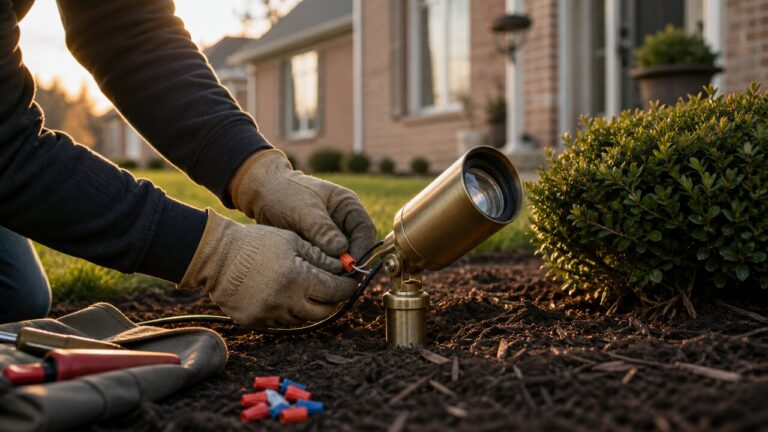
| Gel-Filled Waterproof Wire Connectors | Replacing standard wire nuts with pre-filled dielectric silicone twist connectors | Landscape lighting wire splices, low-voltage branch circuits | Provides rapid, reliable moisture isolation; nevertheless, requires careful wire stripping lengths. |
| Elevated Junction Box Topography | Mounting terminal enclosures on stake extensions or structures above flood levels | Garden beds, turf zones prone to standing water, multi-zone estates | Keeps electrical connections safely above saturation zones; along with potentially impacting landscape aesthetics. |
| Conduit Expansion and Drainage Loops | Installing sweep bends and gravel sumps at low points of underground conduit runs | Commercial parking perimeters, extensive pathway lighting systems | Prevents gravity-fed water accumulation; however, increases excavation and installation labor overhead. |
| Silicone Heat-Shrink Tubing Integration | Applying adhesive-lined heat shrink over soldered or crimped copper joints | Architectural linear runs, step light wiring harnesses | Creates a tight mechanical moisture barrier; nevertheless, requires a heat gun and precise application technique. |
| Gasket and O-Ring Material Upgrades | Swapping standard rubber seals for high-grade fluoroelastomer or silicone gaskets | Facade floodlights, pole-mounted architectural fixtures | Withstands ultraviolet degradation and extreme temperature shifts; however, increases material overhead. |
Realistic Decision Logic
When evaluating these moisture protection strategies against site constraints, facility managers weigh capital investment against long-term maintenance liabilities. Expansive commercial properties warrant epoxy potting and elevated junction boxes because recurring ground faults disrupt commercial operations and inflate repair labor costs. Smaller residential sites likewise focus on gel-filled connectors and proper drainage routing to protect exterior installations economically.
Detailed Real-World Scenarios
A : Corporate Campus In-Grade Uplighting Installation
-
Constraints: A commercial campus featuring dozens of in-grade LED uplights installed in lawn areas prone to seasonal soil saturation and heavy lawn irrigation.
-
Decision Points: Upgrading to factory-sealed epoxy-potted fixtures, installing crushed stone drainage sumps beneath each housing, and utilizing gel-filled wire connectors inside waterproof underground vaults.
-
Failure Modes: Backfilling fixtures with dense native clay soil that traps irrigation water around the housing sides, overwhelming external seals via hydrostatic pressure.
-
Second-Order Effects: Comprehensive subsurface drainage combined with potted luminaires eliminates ground-fault breaker trips and extends fixture lifespan indefinitely.
B : Coastal Residential Estate with Saltwater Spray Exposure
-
Constraints: A coastal property operating landscape lighting fixtures exposed to persistent marine mist, salt spray, and tidal ground moisture.
-
Decision Points: Specifying marine-grade cast brass housings, replacing standard hardware with stainless steel fasteners, and applying dielectric gel to all terminal connections.
-
Failure Modes: Utilizing standard aluminum fixtures that suffer rapid galvanic corrosion when exposed to combined moisture and saline elements.
-
Second-Order Effects: Marine-grade material selection prevents structural housing degradation and stops moisture from breaching internal electronic compartments.
C : Municipal Park Pathway Lighting with Underground Conduit Flooding
-
Constraints: A municipal park utilizing underground PVC conduits that slope toward low-lying junction boxes, resulting in submerged wire splices during heavy storms.
-
Decision Points: Installing drainage weep holes in low conduit points, rerouting junction lines above grade, and sealing all wire entries with waterproof putty.
-
Failure Modes: Sealing junction boxes completely without providing a drainage exit, causing condensation to collect and trap moisture inside the enclosure permanently.
-
Second-Order Effects: Proper conduit re-sloping and elevated termination points prevent water from backing up into fixtures and eliminate recurring short circuits.
D : Commercial Retail Center Facade Lighting with Wall-Pack Sealing Failures
-
Constraints: A retail center experiencing continuous water infiltration through wall-mounted LED floodlights due to degraded rubber gaskets and unsealed conduit entry knockouts.
-
Decision Points: Replacing old gaskets with silicone seals, applying exterior-grade polyurethane sealant around housing perimeters, and sealing bottom conduit knockouts.
-
Failure Modes: Applying sealant to the top and sides of wall packs while leaving the bottom edge open, trapping internal condensation and preventing natural drainage.
-
Second-Order Effects: Correct perimeter sealing stops driven rain from entering luminaire chassis while maintaining proper downward drainage integrity.
Planning, Cost, and Resource Dynamics
Establishing a disciplined approach to preventing outdoor lighting water damage involves balancing upfront material acquisition outlays, professional auditing fees, and long-term maintenance savings. Financial variability typically stems from property scale, fixture count, and soil drainage complexity.
| Moisture Protection Tier | Financial Range (USD) | Primary Variables |
| Basic Connector & Splice Upgrade | $250 – $1,000 total | Gel connectors, dielectric grease, heat-shrink tubing, basic labor |
| Subsurface Drainage & Sump Retrofit | $1,000 – $4,000 | Excavation labor, crushed gravel sumps, conduit re-routing |
| Commercial Enclosure & Junction Overhaul | $4,000 – $15,000 | Waterproof junction boxes, above-grade mounting stakes, terminal blocks |
| Comprehensive Sub-Grade System Redesign | $15,000 – $50,000+ | Factory-potted fixtures, comprehensive civil drainage engineering, heavy trenching |
-
Direct Costs include waterproof wire connectors, marine-grade fittings, epoxy potting compounds, and replacement luminaires.
-
Indirect Costs cover professional electrical troubleshooting, soil excavation labor, and landscaping restoration fees.
-
Opportunity Costs emerge when delaying waterproofing upgrades leads to recurring electrical faults, emergency service dispatch fees, and premature hardware replacement.
Tools, Strategies, and Support Systems
Executing precise moisture mitigation initiatives requires an ecosystem of specialized diagnostic instruments, installation materials, and testing supplies.
-
Insulation Resistance Megohmmeters: Essential for testing the dielectric strength of wire insulation and identifying microscopic moisture breaches before catastrophic shorts occur. Limit: Megohmmeters require isolating sensitive low-voltage drivers to prevent test voltage damage.
-
Waterproof Gel-Filled Wire Connectors: Mechanical twist or crimp connectors pre-filled with non-hardening silicone dielectric compound to seal copper junctions against soil moisture. Limit: Improper wire stripping lengths can expose copper outside the protective gel barrier.
-
Heavy-Wall Heat-Shrink Tubing with Adhesive Lining: Industrial tubing that shrinks under heat application while melting an internal thermoplastic adhesive layer to create a permanent waterproof bond. Limit: Inadequate heat application prevents proper adhesive flow and compromises seal integrity.
-
Plumber’s Putty and Exterior Polyurethane Sealants: Flexible compounds used to seal housing perimeters, conduit entry points, and mounting plate flanges against driving rain. Limit: Low-grade sealants degrade under intense ultraviolet radiation and crack over time.
-
Crushed Drainage Aggregate and Geotextile Fabric: Sub-grade materials placed beneath in-grade fixtures to facilitate rapid percolation and prevent surrounding clay soil migration. Limit: Aggregate beds can become silted over time if geotextile filtration fabric is omitted.
-
Digital Moisture and Soil Saturation Meters: Handheld instruments that measure localized soil water content to identify high-risk drainage zones around landscape lighting runs. Limit: Meters only reflect immediate localized moisture readings and vary across different soil compositions.
Risk Landscape and Failure Modes
Exterior lighting moisture management presents significant technical hazards, subjecting systems to dielectric breakdown, galvanic corrosion, thermal shock, and catastrophic short circuits. Understanding failure modes prevents compounding electrical degradation.
-
Capillary Wick Action into Driver Compartments: Allowing moisture to travel up stranded copper wire strands directly into unpotted electronic enclosures, destroying internal circuit boards.
-
Hydrostatic Seal Failure under Thermal Cycling: Rapid temperature drops creating a partial vacuum inside warm luminaire housings, actively sucking moisture past compromised rubber gaskets.
-
Galvanic Corrosion in Multi-Metal Assemblies: Mixing aluminum housings with copper wire conductors in damp soil environments, triggering rapid electrochemical breakdown of contact points.
-
Sub-Grade Junction Flooding: Burying standard non-waterproof wire nuts in standard soil, leading to immediate ground-fault circuit interrupter tripping upon irrigation activation.
-
Condensation Accumulation in Sealed Housings: Trapping humid ambient air inside a fixture during assembly, which condenses into liquid water droplets as internal temperatures fluctuate.
Governance, Maintenance, and Long-Term Adaptation
Maintaining optimal moisture protection and electrical safety across multi-year operational cycles requires structured governance protocols, regular system audits, and proactive hardware maintenance.
-
Monitoring Cycles: Conducting quarterly insulation resistance testing and seasonal post-storm inspections catches emerging moisture ingress before circuit faults trip breakers.
-
Adjustment Triggers: Technicians initiate corrective drainage modifications whenever landscape grading changes, irrigation head adjustments alter water pooling patterns, or megohmmeter readings indicate declining insulation resistance. Consequently, ignoring initial moisture drift causes permanent driver failure.
-
Layered Maintenance Checklist:
-
Testing circuit insulation resistance using a megohmmeter to verify dry cable integrity.
-
Inspecting exposed above-ground wire splices and junction boxes for cracked housing or seal degradation.
-
Checking in-grade fixture drainage beds for silt accumulation and ensuring rapid water percolation.
-
Inspecting luminaire glass lenses, O-rings, and compression screws for proper torque and tight sealing.
-
Measurement, Tracking, and Evaluation
Evaluating the success of a moisture mitigation program balances quantitative electrical testing metrics against qualitative physical inspection signals.
-
Quantitative Indicators: Measured via diagnostic logs and electrical testing. Key benchmarks include maintaining insulation resistance readings above specified megohm thresholds, eliminating ground-fault trips, and reducing emergency service calls.
-
Qualitative Signals: Assessed through visual verification of dry internal housing compartments, absence of corrosion on terminal blocks, and clear optical lenses free of internal condensation.
-
Documentation Examples:
-
Insulation Resistance Testing Log: Detailed spreadsheets recording megohm values across all exterior lighting circuits over multi-year evaluation periods.
-
Fixture Seal and Gasket Inventory: Comprehensive logs tracking seal replacement dates, material specifications, and manufacturer maintenance schedules.
-
Drainage Audit and Remediation Report: Historical records noting sub-grade drainage performance, regrading adjustments, and sump performance metrics.
-
Common Misconceptions and Oversimplifications
-
Myth: Wrapping standard wire nuts in ordinary electrical tape provides adequate moisture protection for buried landscape lighting splices. Correction: Instead, electrical tape degrades rapidly in damp soil, requiring specialized gel-filled connectors or epoxy potting kits.
-
Myth: All outdoor lighting fixtures are completely waterproof straight out of the factory box regardless of installation depth. Correction: On the contrary, in-grade fixtures depend heavily on proper sub-grade drainage aggregate and professional backfilling to prevent hydrostatic overload.
-
Myth: Applying silicone sealant to the top and sides of a wall-mounted light fixture completely seals it against water damage. Correction: While top sealing helps, blocking the bottom weep holes traps internal condensation and accelerates internal component corrosion.
-
Myth: Low-voltage landscape lighting systems are entirely safe from water damage because they operate on twelve volts. Correction: Rather, while low-voltage systems reduce shock risk, water ingress still causes severe galvanic corrosion, driver burnout, and nuisance circuit breaker tripping.
-
Myth: Standard rubber gaskets last indefinitely under outdoor weathering and do not require periodic inspection or replacement. Correction: In contrast, ultraviolet radiation and temperature extremes harden rubber gaskets over time, destroying their sealing elasticity.
-
Myth: Burying electrical connections deep underground naturally protects them from moisture damage better than above-ground junction boxes. Correction: Industry best practice instead utilizes above-ground junction enclosures or waterproof epoxy vaults where soil saturation is high.
Ethical, Practical, and Contextual Considerations
Responsible exterior electrical management extends beyond property boundaries to support structural safety, prevent electrical hazards, and minimize environmental soil contamination from degraded materials. Unsealed, water-damaged electrical installations pose severe electrical shock hazards in public parks, residential walkways, and commercial courtyards. Furthermore, leaching corrosion byproducts and disintegrating plastic components impact local soil micro-ecosystems and groundwater quality.
Adhering strictly to electrical installation codes, utilizing high-grade waterproof enclosures, and implementing robust sub-grade drainage ensures exterior lighting networks remain safe, durable, and environmentally sound. Balancing engineering precision, material stewardship, and practical maintenance ensures exterior illumination infrastructure operates reliably over decades of service.
Conclusion
Mastering how to avoid outdoor lighting water damage risks requires synthesizing Ingress Protection physics, smart drainage engineering, and professional wire encapsulation techniques. Instead of relying on reactive component swaps or temporary tape patches, facility managers and property owners who implement structured moisture management frameworks build resilient, weather-resistant exterior electrical systems. Consequently, disciplined waterproofing planning transforms recurring maintenance liabilities into predictable, sustainable operational longevity. Thus, rigorous technical evaluation elevates the standard of contemporary landscape infrastructure management.